Description
Enclosure:
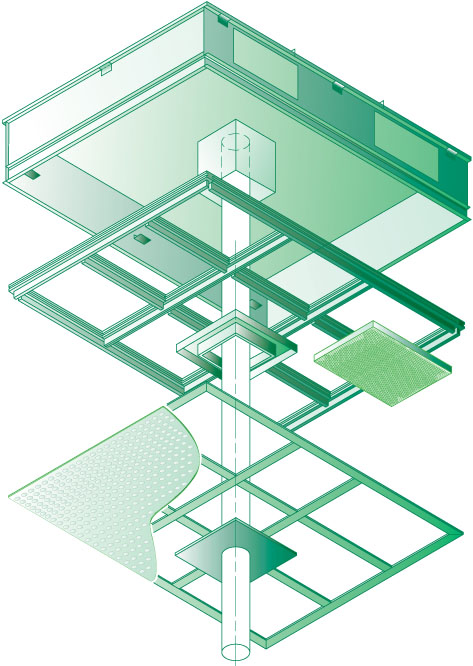
Airtight (Class B according to EN 1886) constructed from 15/10e mild steel plates, with oven-cured white epoxy paint, RAL 9010, for on-site assembly using fasteners. 1.5 mm sheet metal; thanks to its design, noise levels are 48 dB.
Platform:
Rigid, self-supporting structure made of anodized aluminum, Qualanod certified.
Easy assembly and installation:
Access from the operating room, quick adjustment with crush limiter via pre-installed captive stops.
Surgical lamp receptacle:
Watertight
Assembly:
A partially assembled kit is delivered with very detailed instructions. Assembly is completed on-site using standard tools
Filters:
Standard dimensions, HEPA H14 filters in accordance with EN 1822
Seal integrity of the joint:
Maximum local penetration at the joint less than 10⁻⁴ (0.01%)
Control:
Test port installed as standard in the structure
Air purity classification:
Our laminar flow units provide the aseptic core with an ISO 5 air purity classification according to UNE EN 14644
Air flow rates/recirculation rates:
These are calculated based on the customer’s needs and compliance with standards.
ADVANTAGES
1.Simple design and commissioning.
2.Minimal unidirectional flow in dead zones, uniform velocity.
3.EN1822 HEPA terminal filters, with individual test reports.
4.Smooth, decontaminating materials
5.Long-lasting airtightness guaranteed: plenum + Class B EN1866 structure, joint surface: penetration <10,-4 (0.01%)
6.Quick, simple, and safe filter installation.
7.Suitable for on-site filter testing and inspection as specified by the UNE EN ISO 14644-3 standard
Aseptic core
The growing trend within the design and planning of operating theatres is the use of laminar ceilings, with the aim of obtaining ISO class 5 air quality inside operating rooms, in accordance with the ISO 14644 Standard.
Instead of releasing sterile air into the contaminated area to progressively reduce dilution contamination, the new strategy is based on protection focused on an aseptic core that includes the operating table, the clothing of the medical team and all sterile instruments and material. This creates a sterile “piston” of perfectly clean air free of any form of particles, which descends from the filters at low speed so as not to create turbulence
ISO Class 5 Air Quality
To obtain ISO 5 class air quality, it is necessary for the air to flow in a unidirectional manner and avoid forming turbulence that could contaminate the critical area. To create this type of flow it is necessary that the air velocity when leaving the filters is between 0.20 and 0.50 m/s, if it is lower there is no guarantee that the flow will be unidirectional, especially in winter when the temperature of the air supplied is very similar to that of the room and tends to be stratified in the upper part of the room. If the speed is higher, the costs of the operation skyrocket.
Advantages of ISO 5 vs. ISO 7 operating rooms
- Assurance that particles capable of transmitting viral or bacterial contamination do not come into contact with the wound or surgical instruments, offering greater protection to the patient.
- Unlike the positive pressure environments typical of traditional systems that rely on closed doors, the dynamic positive pressure of the aseptic core does not depend on closed doors and therefore offers greater assurance of continuous protection.
- Operating room recovery time is reduced, and availability for use is increased. The time required after a procedure for the system to dilute contamination present in the operating room and restore the required air quality is reduced from approximately 15 minutes with turbulent flow systems (ISO 7) to a few seconds in rooms with unidirectional flow (ISO 5).
- The low-velocity diffusion of air across the entire filter surface and a temperature slightly higher (around 2°C) than the ambient temperature ensures a high level of comfort for the surgeon, far greater than that provided by turbulent airflow systems, which are often characterized by high-velocity, low-temperature air currents.
“All information, specifications, dimensions, and electrical data shown in TDI’s sales materials and data sheets are for reference only and are not binding; therefore, they are subject to change based on each customer’s needs and provided that applicable regulations permit such changes.”
 TDIQUIRO-ENG.pdf